20 June 2011
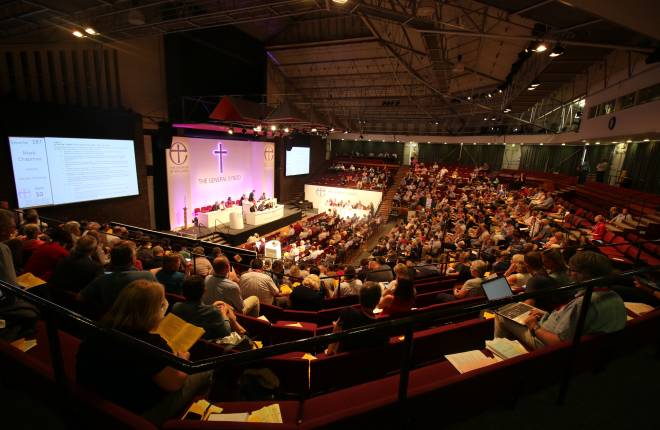
When the Church of England's 'parliament', the General Synod,
meets at York University from 8 to 12 July members will reflect
together on sharing Good News for the world today. Key debates will
centre on the Church's role in education, its work in multi-faith
areas, and relations with other churches.
Other subjects include the impact of higher education changes on
training for the ministry and the involvement of minority ethnic
Anglicans in the Church's ministry and structures.
Sharing Good News for the World Today
The new Synod elected in 2010 has met twice in London, but this
will be its first residential meeting. For the 40 per cent of
members who attended their first Synod last November, this will be
their first opportunity to spend a long weekend residentially in
worship and discussion. The Saturday morning has been structured to
foster a culture of listening and reflection. The theme will be
'Sharing the Good News for the World Today' and the morning will
begin with a keynote Presidential Address by the Archbishop of
Canterbury, Dr Rowan Williams. Members will spend the rest of the
morning in groups of 12, each led by a bishop, listening to each
other as they reflect on the theme. The morning will finish with
worship in the groups.
The Church and Education; the Church in multi-faith
areas
In two debates the Synod will consider specific aspects of the
Church's mission and ministry.
In this 200th anniversary year of the National Society, which
promotes and resources 4,700 Church of England schools (and 172
schools of the Church in Wales), the Synod will be invited to
affirm the continued importance of Church of England schools being
'distinctively Christian institutions, rooted in the life of the
parishes while being open to the diverse communities they
serve'.
The Synod will also consider the Church's work in multi-faith
areas. It will be invited to reaffirm the Church of England's
commitment, in partnership with Christians of other traditions, to
resourcing ministry, witness and mission in multi-faith areas
through the Presence and Engagement Programme, which supports the
work of clergy and congregations in such areas.
Relations with Other Churches
Relationships and dialogue with other Christian churches will be a
recurrent theme in York.
As usual, a number of ecumenical representatives and guests will
be present. The principal guest will be the Archbishop of Tirana,
Durrës and All Albania, His Beatitude Archbishop Anastasios. The
Archbishop, who is the Orthodox President of the World Council of
Churches, will address the Synod on the Friday afternoon.
Following the establishment of communion between the Church of
England and the Church of Denmark, the Bishop of Copenhagen (the Rt
Revd Peter Skov-Jakobsen) will preach at the Sunday Eucharist in
York Minster, at which the Archbishop of York, Dr John Sentamu,
will preside.
The Synod will consider the report of the Church of England's
conversations with the United Reformed Church. Its recommendations
include the holding of a service in Westminster Abbey in February
2012 marking both the 350th anniversary of the separation of
Congregationalist and Presbyterian churches from the Church of
England in 1662 and the 40th anniversary of their coming together
in the United Reformed Church.
The Synod will also be invited to take note of an interim report
on the second phase of the work of the Joint Implementation
Commission for the Anglican-Methodist Covenant.
Higher Education Funding Changes
The forthcoming changes in the funding of higher education will
have significant implications for the cost of training clergy. The
Synod will be invited to endorse far-reaching recommendations on
how the increased cost can be contained, as part of the process
leading to decisions by the Archbishops' Council.
Minority Ethnic Anglicans
The Synod will also consider a report on the inclusion of minority
ethnic Anglicans within the ministry and structures of the Church
of England and will be invited to ask the Archbishops' Council and
the House of Bishops to take steps to implement its
recommendations.
Diocesan Synod Motions
Two motions from diocesan synods will be debated. One, from the
Bradford Diocesan Synod, asks for the admission to Communion of
adults who have been baptized but have not been confirmed and are
not ready to be confirmed. The other, from the London Diocesan
Synod, asks for a review of how the House of Laity of the General
Synod and the houses of laity of the diocesan synods are elected,
and in particular of whom the electorate should comprise.
Private Member's Motion
The Bishop of Southwell and Nottingham, the Rt Revd Paul Butler,
will move a Private Member's Motion calling for a 'national mission
action plan' for the Church of England.
The Synod's other business
There will be the one item of liturgical business: First
Consideration of draft Additional Eucharistic Prayers for use when
a significant number of children are present.
Legislative business will include the Revision Stage of the
draft Church of England Marriage (Amendment) Measure, and a debate
on the Parochial Fees Order, which prescribes fees for weddings and
funerals (the first such Order since the legal framework for these
fees was changed).
The Synod will receive presentations on the Annual Reports of
the Archbishops' Council, and the Church Commissioners. It will
debate the report of the Council's audit committee and will be
invited to approve the Council's budget for 2012.
Communicating Synod
Parishioners can keep in touch with the General Synod while it
meets. Background papers and other information will be posted on
the Church of England website (www.churchofengland.org)
ahead of the General Synod sessions.
A live feed will be available courtesy of Premier Radio
(accessible from front page www.churchofengland.org),
and audio files of debates, along with updates on each day's
proceedings, will be posted during the sessions.