22 November 2012
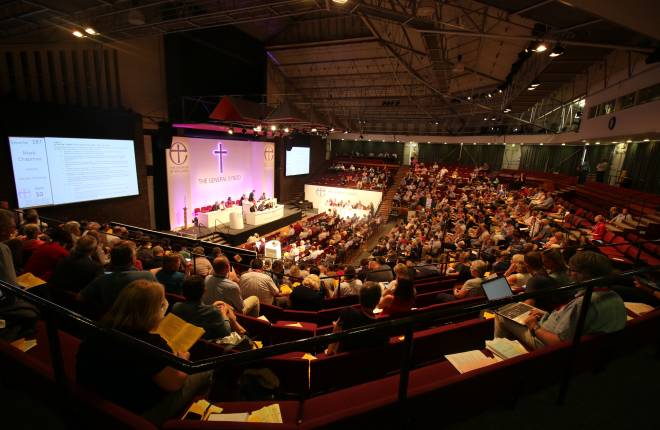
Following Morning Worship, the Archbishop of Canterbury made a
Presidential Statement to Synod, reflecting on his meeting the
previous evening with the Archbishop of York and on the morning's
informal meeting of the House of Bishops.
On behalf of his Diocesan Synod the Rt Revd Paul Butler, Bishop
of Southwell & Nottingham, moved a resolution about allowing
children admitted to Holy Communion before confirmation to help
with the distribution of Holy Communion. (The relevant papers are
Diocesan Synod Motion: Amendment to Canon B12 and Regulations (GS 1881A and GS 1881B).)
After amendment in debate, the resolution was approved in the
following form:
That this Synod requests that Canon B 12 and the Regulations taking
effect under it be amended so that:
(a) the Holy Sacrament may be distributed by any authorized regular
communicant (including children admitted to the Holy Communion
under the Admission of Baptised Children to Holy Communion
Regulations 2006);
(b) if the diocesan bishop agrees, the necessary authorization may
be given in relation to any parish by the incumbent, priest in
charge or (during a vacancy) rural dean; and
(c) no person shall be authorized to distribute the Holy Sacrament
without the support of the parochial church council of the parish
or, where the Holy Communion is celebrated in a school and the
person concerned is a child, of the head teacher of the
school.
(d) the authorization given in relation to any parish is required
to be kept under regular review in accordance with guidelines
issued by the diocesan bishop.
Then John Freeman (Chester) introduced his Private Member's
Motion about the Living Wage. (The relevant papers are Private
Member's Motion: Living Wage (GS 1882A and GS 1882B).) Two
amendments were proposed in debate but both were rejected by the
Synod. By a substantial majority, the motion was therefore passed
in its original form:
That this Synod, recognising that the widening gap between rich and
poor harms all of society and that paying a "Living Wage" lifts
people out of poverty:
(a) affirms the Christian values inherent in the concept of the
"Living Wage"; and
(b) strongly encourages all Church of England institutions to pay
at least the "Living Wage".
As Chair of the Business Committee, the Ven Julian Henderson,
Archdeacon of Dorking (Guildford), introduced the Business
Committee's recommendation that the Synod should not meet in
February 2013 but in November instead. After a brief debate, Synod
agreed to meet in 2013 on 5-9 July and 18-20 November.
Following a presentation under SO 97 about youth unemployment
(Youth Unemployment: Report by
the Mission and Public Affairs Council (GS 1883)), Philip
Fletcher (ex officio) (Chair of the Mission and Public
Affairs Council) successfully moved the motion:
That this Synod, mindful of the corrosive effect of unemployment on
young people, their future prospects and social integration, and
recognising that economic policy solutions alone cannot tackle the
problems without strong networks and initiatives in the community
at large:
(a) encourages parishes and church groups to listen to the voices
of unemployed young people, both locally and through reports such
as "I Am One in a Million", and
(b) commends and encourages the multiplication of church and
community initiatives which can provide training and other support
to assist young people into work and help them manage the
experience of unemployment without despair.
Farewells
The Synod bade farewell to the Bishops of Bath & Wells and
Manchester and to Canon Glyn Webster (Prolocutor of the Province of
York); and also to staff members Dr Colin Podmore and Judith
Gracias.
The Archbishop of York then moved the motion:
'That this Synod record its deep gratitude for the Archbishop of
Canterbury's outstanding ministry to Church and Nation, and offer
him and Mrs Williams its very best wishes for the
future.'
After tributes from the Ven Christine Hardman (Prolocutor of
Canterbury), Dr Philip Giddings (Chair of the House of Laity) and
Archimandrite Ephrem Lash, senior Ecumenical Representative, the
Synod approved the motion with acclamation.
Prorogation
After a final word to members, the Archbishop of Canterbury
prorogued the Synod.
Audio files of both morning and afternoon sessions are
available online.