| ¶ |
|
General
Introduction |
| |
|
|
| |
|
|
| |
|
The patterns of daily prayer in this volume embrace
the three key elements of praise, intercession and engagement with
Scripture which form the heart of the daily praying tradition of
the Church. It is a praying tradition that ranges from the Daily
Office - celebrated as Christians gather together, perhaps with
symbol, movement and song - to other styles of daily prayer, where
individuals reflect on the Scriptures with or without the help of
set forms of prayer, but often using a common scheme of Bible
reading. |
| |
|
|
| |
|
Prayer During the Day, Morning and Evening Prayer
and Night Prayer provide ways of punctuating each day of the week
with praise, prayer and attention to Scripture, Thus, as George
Herbert puts it, 'seven whole days, not one in seven' will we
praise God, pray for God's world and allow ourselves to be formed
and re-formed by God's word. This introduction to Common
Worship: Daily Prayer is intended to help each person or group
to make the most suitable and satisfying use of this provision. It
is followed by some general notes and seasonal notes relevant to
all the Orders of Prayer. More detailed guidance is provided in the
introduction and the accompanying notes to Prayer During the Day,
Morning and Evening Prayer and Night Prayer. |
| |
|
|
| |
|
|
| |
|
Where to Start
|
|
| |
|
|
| |
|
A regular pattern
|
|
| |
|
|
| |
|
Whether Common Worship: Daily Prayer is
used by an individual, a small group, a parish at prayer or a
religious community, the first decision to make is what the regular
pattern of worship is to be. What is chosen will depend on a number
of circumstances, including the time available. One of the
following patterns may be worth considering: |
| |
|
|
| |
|
¶ |
Simply using Prayer During the Day, perhaps
balancing this with Night Prayer. |
| |
|
|
|
| |
|
¶ |
Following the fuller diet of Morning and/or Evening
Prayer. |
| |
|
|
|
| |
|
¶ |
Using both Morning Prayer and Evening Prayer with
Night Prayer. |
| |
|
|
|
| |
|
¶ |
Celebrating a four-fold Office of Morning Prayer,
Prayer During the Day in the form of Midday Prayer, Evening Prayer
and Night Prayer. |
| |
|
|
|
| |
|
Some will also be taking part in a daily
celebration of the Holy Communion. |
| |
|
|
|
| |
|
Penitence
|
|
| |
|
|
| |
|
There is also a decision to be made about whether
or when to use one of the Forms of Penitence. This may depend
on whether the Holy Communion or Night Prayer, both of which
usually include prayers of penitence, are being celebrated that
day. |
| |
|
|
| |
|
Optional material
and choices
|
|
| |
|
|
| |
|
Further judgements will be needed about how much of
the optional material in each order will be appropriate and which,
if any, of the various alternative texts will be used. Choices will
also be influenced by the way in which those who use this book
decide to listen to God through Scripture in their daily prayer. It
is advisable, once choices have been made, to use them consistently
for at least four weeks before any change is made. |
| |
|
|
| |
|
|
| |
|
What to Read
|
|
| |
|
|
| |
|
Common Worship: Daily Prayer is designed
to be used with the Common Worship lectionaries. The
annual lectionary booklet, which will need to be at hand, provides
two tracks of readings suitable for the office, each with an Old
Testament and a New Testament reading. Here are some questions that
might be asked in deciding what to read: |
| |
|
|
| |
|
How many readings might be read each
day? |
| |
|
|
| |
|
¶ |
Those who are praying twice a day, morning and
evening, may simply follow both tracks in the lectionary booklet, a
total of four readings a day. |
| |
|
|
|
| |
|
¶ |
Those who pray only once a day may use just one of
the tracks. |
| |
|
|
|
| |
|
¶ |
Those who wish to concentrate on one biblical book
at a time may follow just one of the readings from one of the
tracks for a period, alternating between New Testament and Old
Testament readings to retain a balance. |
| |
|
|
|
| |
|
Can those who pray more than once a day
create a varied pattern of prayer, praise and Bible reading? |
| |
|
|
|
| |
|
¶ |
Many people will use the Common Worship
weekday lectionary at Morning and Evening Prayer, for which it is
primarily designed. Prayer During the Day can then be a simple act
of praise and prayer, possibly in the form of Midday Prayer. |
| |
|
|
|
| |
|
¶ |
Others may want to use Prayer During the Day as
their opportunity for sustained engagement with Scripture and will
concentrate their reading of Scripture there, thus freeing Morning
or Evening Prayer to focus more on praise and intercession. In this
case, the Common Worship weekday lectionary may be used at
Prayer During the Day, whilst the short reading set for Prayer
During the Day may be used within Morning or Evening Prayer. |
| |
|
|
| |
|
There are many possible combinations. The important
thing is to make responsible decisions about the use of Scripture
that allow for reflection on God's word, and for the offering of
praise to God and prayer for God's world in a balanced way during
the day and week. |
| |
|
|
| |
|
|
| |
|
Choosing the
Psalmody
|
|
| |
|
|
|
|
| |
|
The Common Worship weekday lectionary
provides psalm cycles designed to be followed at Morning and
Evening Prayer. |
| |
|
|
| |
|
Three shorter psalm cycles are provided in this
book, all of which are intended primarily to be used with Prayer
During the Day. |
| |
|
|
|
| |
|
¶ |
Two
tables making use of Psalm 119 and the Psalms of Ascent (Psalms
121-131 and 133) on a weekly, fortnightly or monthly pattern. |
| |
|
|
|
| |
|
¶ |
A monthly psalm cycle for ordinary time (found
within the daily orders for Prayer During the Day). |
| |
|
|
|
|
| |
|
¶ |
A weekly psalm cycle for the seasons (found within
the seasonal orders for Prayer During the Day). |
| |
|
|
| |
|
If a pattern of Prayer During the Day, Morning and
Evening Prayer is followed, it is recommended that the first of the
above schemes for Prayer During the Day is followed, since there
will be less likelihood of repetition in the psalmody. |
| |
|
|
| |
|
¶ |
As with the Bible readings, the psalmody may be
swapped between services, in a regular pattern. If several offices
are said during the day and a more substantial diet of praise and
psalmody is required at Midday Prayer, part of the Psalm provision
in the Common Worship weekday lectionary may be used at
Prayer During the Day, whilst one of the shorter Prayer During the
Day cycles may be used at Morning or Evening Prayer. |
| |
|
|
|
| |
|
¶ |
Suggested psalmody for Night Prayer is found within
the order for Night Prayer itself and on the pages of daily and
seasonal variations. |
| |
|
|
| |
|
|
| |
|
Where to Look in Daily
Prayer
|
|
| |
|
|
| |
|
¶ |
The Contents pages indicate where each order
of Prayer can be found. |
| |
|
|
|
| |
|
¶ |
It will also be necessary to know the time of the
Christian year. This can be found out from the Seasonal Notes (or from the annual
lectionary booklet). |
| |
|
|
|
| |
|
¶ |
In Ordinary Time, there is a separate order
for each day of the week for Prayer During the Day, Morning and
Evening Prayer. There is also daily
provision for Night Prayer. |
| |
|
|
| |
|
¶ |
For each liturgical Season, there is a separate
order for Prayer During the Day, Morning and Evening Prayer. There
is also seasonal
provision for Night Prayer. |
| |
|
|
| |
|
¶ |
The Collects and suggested canticles and refrains
for Ordinary Time, for the seasons and for Holy Days may be found here. The Holy Days are
set out in the Calendar. |
| |
|
|
| |
|
¶ |
The General Notes should also be
consulted. |
| |
|
|
| |
|
|
| |
|
Setting the Scene
|
|
| |
|
|
| |
|
Attention to the place of prayer is important for
those who are praying with others as much as for those who are
praying by themselves. |
| |
|
|
| |
|
¶ |
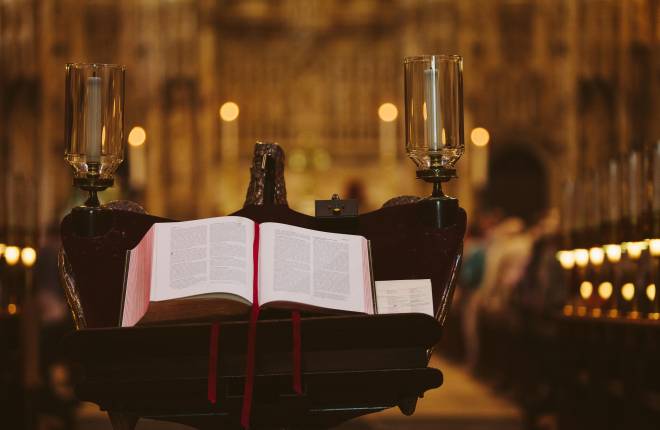
A group may find it helpful to sit in a semi-circle
in an appropriately sized space, around a lectern on which the
Bible is placed, rather than behind each other in pews in the main
body of the church. An individual might sit regularly in a
particular place, before an open Bible. |
| |
|
|
|
| |
|
¶ |
Another focus may be found helpful, in addition to
or occasionally in place of the lectern or Bible, such as a cross,
a candle, an icon, a symbol of the season or some other Christian
symbol. |
| |
|
|
|
| |
|
¶ |
Other locations (e.g. around the font for the Thanksgiving
for Holy Baptism) may be suitable on different occasions, or
during particular seasons. |
| |
|
|
|
| |
|
¶ |
For those praying alone, anything that helps to
give a sense of sharing in the prayer of the whole Church is to be
welcomed. |
| |
|
|
| |
|
|
| |
|
Deciding How
|
|
| |
|
|
| |
|
The way in which these Orders are celebrated helps
or hinders the prayer of the worshipping group. Here are some
well-tried suggestions: |
| |
|
|
| |
|
¶ |
It is good to involve a number of people in leading
and participating: reading from the Bible, for example, reading or
leading the psalmody, or contributing biddings at the Prayers of
Intercession. |
| |
|
|
|
| |
|
¶ |
Singing, however simply, and even on one's own,
helps to deepen the worship. Singing can also unite a group or
congregation, enriching their prayer and praise. |
| |
|
|
|
| |
|
¶ |
A gentle and regular pace will also help to achieve
this unity and focus the worship on God. |
| |
|
|
|
| |
|
¶ |
Silence is not only an essential element of prayer
and reflection, but also an effective way of binding the community
together. It may be used at various points in any of the orders of
prayer. |
| |
|
|
|
| |
|
¶ |
Body posture is important, too. Even those who are
praying alone will find that appropriate variation of position
makes a positive difference. |
| |
|
|
|
| |
|
¶ |
All of the Orders lend themselves to the use of
symbols and simple actions. A rough wooden cross in Passiontide,
the Paschal Candle during Eastertide, icons of saints from All
Saints' Day until Advent are some seasonal ideas. The lighting of
candles at appropriate points in the Forms of Penitence and, of
course, during the Blessing of Light, followed
perhaps by the burning of incense in a censer or a simple pot
during the singing of Psalm 141, are obvious and natural ways of
expressing the liturgical words in action. |
| |
|
|
| |
|
Decisions about singing, silence, symbol and the
leading of the order of prayer should be made in advance, together
with other necessary preparations. This ensures that worship can be
offered by a well-prepared and confident praying community. |
| |
|
|
| |
|
|
| |
|
How to Recite
|
|
| |
|
|
| |
|
Whether singing or speaking, there are different
ways of treating psalms and canticles. |
| |
|
|
|
|
| |
|
¶ |
Some of the psalms, such as the more personal and
penitential ones, are perhaps best spoken by a single voice.
Everyone is encouraged to join in saying 'Glory to the Father…' at
the end. |
| |
|
|
|
|
| |
|
¶ |
Other psalms may be recited alternately (different
individuals or groups taking alternate verses) or responsorially
(using the refrain provided for the psalm) at
the beginning, end and whenever the symbol R appears. |
| |
|
|
|
|
| |
|
¶ |
Certain psalms are best recited corporately; this
is particularly appropriate for the opening canticles. |
| |
|
|
|
|
| |
|
¶ |
The other canticles also have a refrain (sometimes
called an antiphon) which is provided to set the tone. The antiphon
both gives an indication of the daily or seasonal emphasis and
provides text for an easily memorized musical response. It is
usually used at the beginning and end of a canticle but, if this
refrain is all that the people say or sing, it may be repeated
regularly throughout the canticle. |
| |
|
|
|
|
| |
|
¶ |
Even when praying alone, individuals may find that
their act of praise and prayer is transformed by reading
aloud. |
| |
|
|
|
|
| |
|
|
|
|
| |
|
Being Part of
a Wider Community of Prayer |
|
| |
|
|
| |
|
Finally, although these are flexible Orders of
Prayer that can be used in different ways according to the needs of
particular praying people and communities, they will also, through
common structures, texts and patterns of Scripture reading, unite
those using them into one larger community of prayer. This
community extends to all of those who, through the ages and across
the nations, have sought to do as Jesus taught us and pray together
for the hallowing of God's name and the coming of God's
kingdom. |
| |
|
|
| |
|
|