Frequently asked questions
In these pages we hope we've answered all the questions you may
have. Please talk to your local parish priest for any more
information on confirmation.
Q. What is the right age for
confirmation?
Q. How can I tell if I am ready for
confirmation?
Q. Can I receive communion without being
confirmed?
Q. I was baptized as a child, why do I need
to be confirmed?
Q. I'm not a regular churchgoer. Can
I still be confirmed?
Q. Why does the Church of England baptize
babies and children rather than adults as in some other
denominations?
Q. What if I wasn't baptized as a
child?
Q. What does it cost?
Q. What happens during confirmation
classes?
Q. Do I have to wait for a group of people
wanting to be confirmed?
Q. What happens after confirmation?
Q. Can I be baptized or confirmed
again?
Q. What if I worship at a Local Ecumenical
Partnership?
Q. What if I was baptised or confirmed
in another denomination?
Q. Do I need to be confirmed to work for the
Church of England?
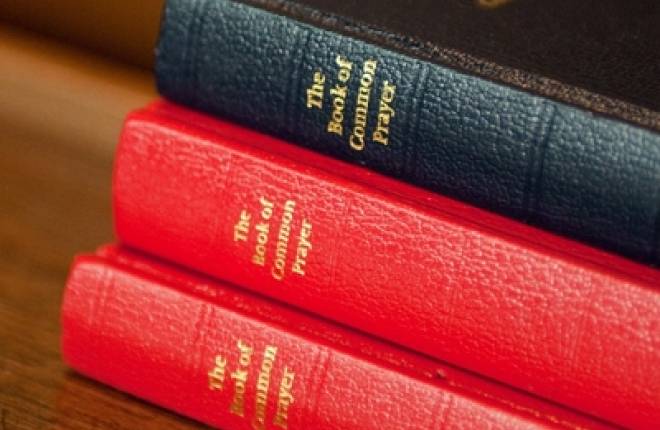
Q. What's the difference between the Common
Worship and Book of Common Prayer Service?
Q. What is the Affirmation of Baptismal
Faith?
Q. What is the right age for confirmation?
There is no right age for a person to be confirmed. Anyone may
be confirmed who has been baptized, if they are old enough to
answer responsibly for themselves. In many dioceses, however, the
diocesan bishop has set a minimum age for Confirmation. If this is
the case your parish priest will be able to tell you what the
minimum age is. As a general rule anyone who is over 10 years old
and can answer for themselves could be ready for confirmation but
the right time for you might be at any age.
Q. How can I tell if I am ready for confirmation?
A. Young people mature in their faith in different ways and at
different ages. It is important that you come to Confirmation with
firm personal conviction that it is right for you at this point in
your life. You should pray about this and ask others in your church
to pray for you. You should talk to your vicar and even if you are
unsure about being confirmed you may wish to participate in the
confirmation course to explore your faith further as you think
about it.
Q.Can I receive communion
without being confirmed?
Confirmation is about so much more than receiving the bread and
wine. Anyone in preparation for the confirmation can receive
communion as part of that preparation. In some dioceses children
are admitted to Holy Communion when they reach an age at which they
can understand the meaning of the Eucharist or Holy Communion (to
the extent as any of us ever can understand it). This means that
some young people will come to confirmation having been
participating in Holy Communion while others will receive their
first Communion after Confirmation.
Q. I was baptized as a
child, why do I need to be confirmed?
If you were baptized as a child, in confirmation, you are
confirming the promises your parents made on your behalf at your
baptism about your commitment to a journey of faith. In confirming
this faith you are becoming a member of the local and worldwide
Christian family. In turn the Church will promise to support and
pray for you.
In confirmation we recall the promises made at baptism, we are
thanking God for his gift of life and publicly acknowledging his
love. We are acknowledging that we all need to turn away from
selfishness and evil and to accept God's offer of a new start.
Q. I'm not a regular
churchgoer. Can I still be confirmed?
A. Confirmation is about becoming a committed member of the
local and worldwide Christian family. If you would like to make
this commitment we recommend you visit your local church and
discuss this with your local vicar. Details of your local church
may be found at www.achurchnearyou.com
Q. Why Does the Church of
England baptize babies and children rather than adults as in some
other denominations?
The Church of England baptises children and adults. Usually
adults seeking baptism are encouraged to explore a combined baptism
and confirmation.
There are four reasons why the Church of England, unlike some
other Christian traditions, has retained the practice of infant
baptism.
- First, infant baptism is a practice that goes back to the very
earliest days of the Church and is therefore something that the
Church of England does not feel free to discard.
- Secondly, the Church of England believes that God's merciful
love, what Christians call God's 'grace', always precedes our human
response and enables it. Personal confession of faith following on
from and responding to the grace of God received in infant baptism
is consistent with this fact.
- Thirdly, we read in the gospels that Christ welcomed and
blessed those infants that were brought to Him (Mark 10:13-15) and
the Church of England believes that infant baptism is a way He
continues to do this today.
- Fourthly, the Bible as a whole tells us that the children of
believers are themselves part of God's family and therefore The
Church of England feels that it is right that they should have the
sign of belonging to the family just as Jewish boys in the Old
Testament had the sign of circumcision (Genesis 17:9-14, Acts 2:39,
16:31, 1 Corinthians 7:14).
Q. What happens after confirmation?
A. If you were prepared for confirmation with other candidates,
your group may wish to continue journeying in faith together after
Confirmation.
You might consider the course Get
a Life amongst others as a resource for this. If you were
prepared as an individual you might ask your vicar or whoever
prepared you about house groups at your church or you may wish to
explore Spiritual Direction.
Q. What if I wasn't baptized as a child?
If you were not baptized as a child and want to make a
commitment of faith, you might consider adult baptism or you can be
baptized and confirmed in the same service or baptized shortly
before your confirmation. You should discuss this with your
vicar.
Q. What does it cost?
A. A confirmation service is free, though there may be a small
charge for a certificate. Ask your parish priest.
Q. What happens during confirmation classes?
A. The purpose of confirmation preparation is to ensure that
those who are confirmed have a proper understanding of what it
means to live as a disciple of Christ within the life of the Church
of England. In The Book of Common Prayer it is envisaged that this
preparation will take the form of learning by heart the Apostles
Creed, the Ten Commandments, the Lord's Prayer, and The Book of
Common Prayer Catechism.
Today preparation focuses less on learning by rote and more on
enabling young people to live a life of committed discipleship in a
world of multimedia and globalised culture. Sessions encourage
candidates to grow in their Christian faith through prayer,
reflection, studying the Bible, participating actively in the life
of the church and demonstrating their faith in their
communities.
Q. Do I have to wait for a group
of people wanting to be confirmed?
A. An individual church or group of churches will sometimes have
a large group of young people wishing to be confirmed and sometimes
a much smaller group of even one or two. This should not be a bar
to preparing these young people for confirmation.
Q. Can I be baptized or confirmed again?
You can only be baptized or confirmed once in the Church of
England, but there are ways of renewing your Christian commitment
publicly as an adult. One of these is the Affirmation of Baptismal Faith - your
priest will be able to advise you.
Q. What if I worship
at a Local Ecumenical Partnership?
As far as the Church of England is concerned, joint Confirmation
means the holding of a service of Confirmation of the Church of
England together with that of one or more other churches which
practice Confirmation and accept the Anglican rite. These will
normally be the Methodist, United Reformed, Moravian or Lutheran
churches. Joint Confirmation with the Roman Catholic Church is not
permitted by its Canons.
In a joint Confirmation the confirming minister from the Church
of England is always a bishop. In the case of the other churches it
is the appropriate minister in terms of their practice. Those who
are confirmed in this way are confirmed both in the Church of
England and in the other churches involved.
Joint confirmation is a practice which takes place in many, but
not all, dioceses of holding joint services of Confirmation in
which candidates from Local Ecumenical Partnerships (LEPs) are
confirmed by ministers of the different churches to which the LEPs
concerned belong.
The reason for this practice is that since candidates for
Confirmation who belong to a single Christian church are confirmed
within that tradition by an appropriate minister from that
tradition, it is therefore right that candidates for Confirmation
who identify with more than one church because of their having come
to faith in an LEP should be jointly confirmed within all the
churches concerned by the appropriate ministers from those
churches.
In addition, joint Confirmation also expresses the joint or
shared oversight of the LEP by the appropriate ministers of these
churches. It is a sign that all the churches involved accept their
responsibility for pastoral oversight of that LEP.
Q. What if I was
baptised or confirmed in another denomination?
Those who have been confirmed in a church whose ministerial
orders are recognised and accepted by the Church of England and in
which confirmation is performed by a bishop, or by a priest acting
on the bishop's behalf and using chrism blessed by the bishop, do
not need to be confirmed. They are simply received into the Church
of England instead. This is a simpler service than communion which
may be led by the Bishop or the parish priest, saying
You are here to be received into the
communion of the Church of England.
Do you acknowledge the Church of England as part of the one, holy,
catholic and apostolic Church?
I do.
Do you accept the teaching, discipline and authority of the Church
of England?
I do.
Will you take part with us in worship and mission?
I will.
The president takes the hand of each person to be received,
saying
(Name), we recognize you as a
member of the one, holy, catholic and apostolic Church; and we
receive you into the communion of the Church of England
in the name of the Father, and of the Son, and of the Holy
Spirit. Amen.
( Read the text)
However the Canons lay down that Christians from churches in
which confirmation is not performed by a bishop need to be
confirmed by a bishop if they wish formally to be admitted into the
Church of England.
Q. Do I need to be confirmed to
work for the Church of England?
The Canons lay down that those who wish to exercise certain
leadership roles in the Church of England, including ordained
ministers, readers and licensed lay workers need to be confirmed as
a sign of their commitment to living as disciples of Christ as the
Church of England understands it
Q. What's the difference between the
Common Worship and Book of Common Prayer Service?
A. The Book of Common Prayer confirmation rite is brief. It
consists of:
- A declaration by the candidates that they renew the 'solemn
promise and vow' made on their behalf at their baptisms. A
prayer by the people led by the bishop asking that God will
strengthen those who are confirmed with the Holy Spirit and that
they will be given the sevenfold gifts of God's grace mentioned in
Isaiah 11:2.
- The laying on of hands by the bishop with the words: 'Defend. O
Lord this thy child [or this thy servant] with thy heavenly grace,
that he may continue thine for ever; and daily increase in thy Holy
Spirit, more and more, until he come unto thy everlasting
kingdom.'
- Prayers led by the bishop which ask that God's Fatherly hand
will be over the candidates, that His Holy Spirit will ever be with
them and that they will be led by God to attain everlasting
life.
Although the basic elements of the rite remain the same, The
Common Worship Confirmation rite is longer and contains a number of
additional elements:
It begins with the bishop asking the candidates to state whether
they are ready to be baptised or have been baptised already and
whether they are willing to affirm their faith in Jesus Christ. At
this point candidates may be invited to give their testimony - a
brief statement about how God has brought them to this point in
their lives.
The bishop then asks the candidates to repeat the renunciation
of the devil and all that is evil and the declaration of turning to
Christ from the baptism service.
If there are any candidates who have not been baptised they are
next baptised by the bishop. After this has taken place all the
candidates join with the bishop and the rest of the congregation in
reciting the Apostles' Creed as an expression of the Christian
faith into which they were baptised and which they are now
affirming for themselves. They may then be signed or sprinkled with
water as a reminder of their baptism and of their need to remain
faithful to the commitment to God that their baptism involved.
Using words based on Isaiah 11:2, the bishop leads the people in
praying for the Holy Spirit to rest upon those being confirmed and
following this confirmation prayer the bishop addresses each
candidate by name and says:
'[Name] God has called you by name and made you his own.'
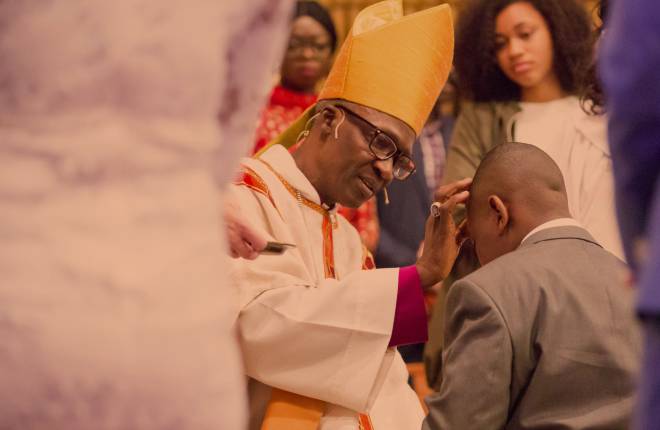
The bishop then lays his hand on the head of each candidate,
saying
'Confirm, O Lord, your servant [Name] with your Holy
Spirit.'
Each candidate replies Amen.
When all have been confirmed in this way, the bishop invites the
congregation to join with him in praying:
'Defend, O Lord, these your servants with your heavenly
grace,
that they may continue yours for ever,
and daily increase in your Holy Spirit more and more
until they come to your everlasting kingdom. Amen.'
The bishop may then use words of commissioning in which the
candidates are able to express their determination, with the help
of God, to live a life of Christian discipleship and the candidates
may also be anointed with oil as an additional sign of their
anointing by the Holy Spirit.
The texts of the Confirmation services are available on
this website.
The Book of Common Prayer
Common Worship
Q. What is the
Affirmation of Baptismal Faith?
There is a new rite contained in the Common Worship initiation
services called the Affirmation of Baptismal Faith. It is intended
for people for have been baptised and confirmed and who want a
formal way of marking either that they have returned to the
practice of the Christian faith or that their faith has become
meaningful to them in a new way.
Affirmation of Baptismal Faith is preceded by preparation. If it
takes place in the context of a confirmation service it is presided
over by the bishop. When this is not the case a parish priest may
preside. The affirmation consists of the following elements:
- A declaration that those involved have been baptised and wish
to renew their faith.
- The renunciation of the devil and all that is evil and
declaration of turning to Christ from the baptism service.
- An affirmation of faith using the words of the Apostles'
Creed.
- A threefold declaration of commitment to God, Father, Son and
Holy Spirit:
'I answer the call of God my
creator.
I trust in Christ Jesus as my
saviour.
I seek new life from the Holy
Spirit.'
- A prayer by the bishop or the parish priest:
'God of mercy and love,
In baptism you welcome the
sinner
and restore the dead to life.
You create a clean heart in those
who repent,
and give your Holy Spirit to those
who ask.
Grant that these your servants may
grow
into the fullness of the stature of
Christ.
Equip them with the gifts of your
Holy Spirit,
and fill them with faith in Jesus
Christ
and with love for your people,
in the service of your kingdom.
Amen'
The laying on of hands by the bishop or the parish priest with
the words:
'N, may God renew his life within
you
that you may confess his name this
day and for ever.'
and each candidate replying
'Amen.'